Break Up the Banks! by David Shirreff
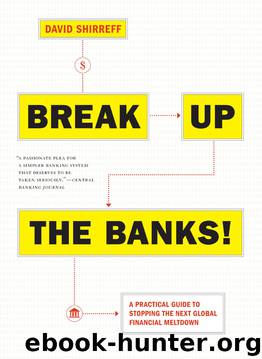
Author:David Shirreff [Shirreff, David]
Language: eng
Format: epub
ISBN: 978-1-61219-503-2
Publisher: Melville House
Published: 2016-03-28T16:00:00+00:00
Whose Capital?
Equity investors in private listed companies expect a return, either through a dividend or through capital growth. When that company is heavily regulated—as in the case of a water utility or a bank—investor expectations are slightly different. Heavy regulation normally means the company is likely to have steadier, but lower, profits.
Recently, investors in banks have sought consistently high returns—but have instead got more volatile returns, anything from 25 percent to a negative return on equity (ROE). A more stable financial sector would attract the utility-type investor, but not the chaser of high risk/high return. Can a reformed and stable financial sector offer investors attractive enough returns? Probably not, unless investors sharply lower their expectations.
Recent share issues by banks such as Deutsche Bank and Barclays have suggested a cost of capital for major international banks of around 10 percent. This means that a Deutsche Bank, Barclays, Credit Suisse, or BNP Paribas would have to aim for a return on equity of 15 percent or more: these days, they are lucky if they produce a 5 percent return.
Given the heavy regulatory and compliance burdens that are placed on institutions categorized as systemically important, it is a huge challenge for banks to produce an ROE consistently over 10 percent. The risk (and it is a risk grounded in the recklessness that preceded the financial crisis) is that the bank’s executives will “massage” returns rather than concentrate on the bank’s stability and on improving service to customers. Some adjustment of investors’ expectations is therefore necessary. But it is worth emphasizing that investors might also benefit from two positive effects. Simplifying banks (and banking rules) would
Download
This site does not store any files on its server. We only index and link to content provided by other sites. Please contact the content providers to delete copyright contents if any and email us, we'll remove relevant links or contents immediately.
The Brazilian Economy since the Great Financial Crisis of 20072008 by Philip Arestis Carolina Troncoso Baltar & Daniela Magalhães Prates(369765)
International Integration of the Brazilian Economy by Elias C. Grivoyannis(111640)
The Art of Coaching by Elena Aguilar(53710)
Flexible Working by Dale Gemma;(23365)
How to Stop Living Paycheck to Paycheck by Avery Breyer(19839)
Thinking, Fast and Slow by Kahneman Daniel(12551)
The Acquirer's Multiple: How the Billionaire Contrarians of Deep Value Beat the Market by Tobias Carlisle(12438)
The Radium Girls by Kate Moore(12211)
The Art of Thinking Clearly by Rolf Dobelli(10736)
Hit Refresh by Satya Nadella(9267)
The Compound Effect by Darren Hardy(9173)
Tools of Titans by Timothy Ferriss(8620)
Atomic Habits: Tiny Changes, Remarkable Results by James Clear(8535)
Turbulence by E. J. Noyes(8231)
A Court of Wings and Ruin by Sarah J. Maas(8127)
Change Your Questions, Change Your Life by Marilee Adams(7944)
Nudge - Improving Decisions about Health, Wealth, and Happiness by Thaler Sunstein(7867)
How to Be a Bawse: A Guide to Conquering Life by Lilly Singh(7636)
Win Bigly by Scott Adams(7356)
